16jul
MISSISSIPPI COMMUNITY COLLEGE SYSTEM PROPOSES NEW PERFORMANCE-BASED WORKFORCE INVESTMENT
PROGRAM
News
July 16, 2026
Mississippi's community colleges have proposed a new performance-based workforce investment
initiative that would prepare an estimated 5,500 additional workers each year for
high-priority careers while tying new state funding directly to workforce outcomes. 
The Jobs Promise Performance Program (JPPP), recently approved as part of the Mississippi
Association of Community College’s (MACC) legislative agenda for the 2027 session
of the Mississippi Legislature, is a new concept in workforce development and performance-based
investment. Should the program receive funding by the legislature, it will allow the
State of Mississippi to make targeted investments aimed at equipping an additional
5,500 workers annually with skills required for high-priority occupations, to promote
economic growth in the state.
"Across Mississippi, there is an important conversation taking place about accountability
in public education and the return taxpayers receive on their investment," said Dr.
Scott Alsobrooks, president of East Mississippi Community College and co-chair of
the MACC Legislative committee. "The Jobs Promise Performance Program reflects our
belief that community colleges should be measured not simply by how many students
enroll, but by how many of those students complete high-priority workforce programs
and enter careers that strengthen Mississippi's economy. This proposal demonstrates
our willingness to align public investment with measurable results."
As policymakers in Mississippi continue discussing how public education can better
serve its stakeholders, such as students, employers and taxpayers, the ongoing debates
about accountability and performance-based investments center on a common question:
How should public investment be measured by public outcomes?
The Jobs Promise Performance Program suggests one way to do that.
Dr. Courtney Taylor, executive director of Accelerate MS said, “Mississippi's workforce
momentum requires us to continually think about how we align education, training,
and economic opportunity. Conversations like this are valuable because they keep the
focus on preparing more Mississippians for high-demand careers while ensuring public
investments deliver meaningful results.”
Instead of just looking into enrollment numbers, the proposed program focuses on successful
completion of high-priority workforce programs and producing graduates who are prepared
to join Mississippi’s workforce. By tying community college performance to Mississippi’s
economic development needs, the initiative provides additional incentive to increase
the number of graduates working in occupations that are experiencing shortages.
"Mississippi’s Jobs Promise Performance Program shows our commitment to give our students
the tools they need for the current workforce," said Dr. Ricky G. Ford, president
of Northeast Mississippi Community College and chair of the MACC. "By aligning education
with workforce demands, we are helping to both improve job prospects for our graduates
and facilitate economic development of our communities. It is all about making sure
that the process of transitioning from education to workforce becomes smooth and efficient."
At the recent Mississippi Association of Community College Trustees conference, Mississippi
community college leaders discussed workforce demands in Mississippi. Additionally,
it is estimated that the state will need tens of thousands of additional trained workers
in the coming years to meet workforce demands in advanced manufacturing, healthcare,
logistics, aerospace, IT and other high growth industries. The Jobs Promise Performance
Program was developed in response to these workforce challenges.
Should the program receive approval from the Mississippi Legislature, it will introduce
a new economic development priority as part of the community college funding model
and recognize workforce production as the measure of the statewide investment.
“For decades, Mississippi’s community colleges have responded to changes in employer
demands by launching training programs in advanced manufacturing, healthcare, transportation,
IT, public safety, construction and many other high-priority industries,” said Dr.
Michael Heindl, president at Northwest Mississippi Community College and co-chair
of the MACC Legislative committee. “The Jobs Promise Performance Program builds on
that tradition by encouraging and incentivizing colleges to produce even more graduates
in the industries that are driving Mississippi's future economy.”
The program will require an investment of $41.5 million in exchange for the preparation
of an estimated 5,500 additional workers annually in high-priority sectors, highlighting
once again the historic role of the community college system in Mississippi as the
primary provider of workforce training.
Kell Smith, executive director of the Mississippi Community College Board (MCCB),
added: "Our college missions have always been to empower Mississippians through education
and training. The Jobs Promise Performance Program continues that mission by rewarding
results that matter — more skilled workers, stronger employers and continued economic
growth across Mississippi.”
As discussions about the future of public education funding in Mississippi continue,
the program demonstrates the community college system’s commitment to performance,
partnerships, and delivering value to its stakeholders.
Partnering with local industries
East Mississippi Community College works closely with local industries to identify
area workforce needs and tailor training to provide skills to meet the needs of existing
and incoming industries.
“The Jobs Promise Performance Program mirrors much of what we are already doing through
our career technical and workforce programs,” EMCC Vice President of Career Technical
and Workforce Education Dr. Michael Busby said. “Our focus is on preparing students
for careers in fields that are in demand locally, whether that is with existing industries
or new industries locating to our area.”
A case in point is Huber Engineered Woods. In October 2024, a year after the company
announced the construction of a $418 million state-of-the-art oriented strand board
manufacturing plant on a 551-acre site in Shuqualak, Plant Manager Elden Padgett visited
The Communiversity at EMCC, which houses programs of study that prepare students for
careers in advanced manufacturing.
The plant, which will produce subflooring, and wall and roof sheathing, will be the
company’s most technologically advanced facility to date, with automated production
processes.
Padgett said during his 2024 visit to The Communiversity that graduates of EMCC’s
programs of study that offer training in automation and programmable logic controllers,
which can direct a wide range of manufacturing processes, will help provide the company
with a pool of potential candidates for hire. Those EMCC programs include Systems
Based Automation, Mechatronics Technology and Industrial Maintenance.
Some positions have been filled at the plant for the initial startup, with plans to
employee more than 150 people once the facility reaches full production. EMCC’s Workforce
and Community Services division on the Scooba campus has been involved in some initial
training at Huber’s Noxubee County plant, providing forklift certification for employees,
among other things.
In 2022, at the request of local employers, EMCC added Heavy Civil Construction and
Electrical Technology programs at the Scooba campus to meet local needs. Other workforce
and career technical programs on that campus included Welding Technology, Computer
Networking Technology, Utility Lineworker, Forestry Technology, Business & Marketing
Management Technology and Funeral Service Technology. Plans are in the works to add
additional workforce programs on the campus in the future.
EMCC also provides incubator space for startups at The Communiversity, which is located
in Lowndes County near the college’s Golden Triangle campus. Following a 2023 groundbreaking
ceremony for Terberg Taylor Americas Group, LLC, office space was provided at The
Communiversity to officials with the company that produces terminal tractors used
to transport cargo containers and semi-trailers short distances in cargo yards, warehouses,
ports and transportation hubs.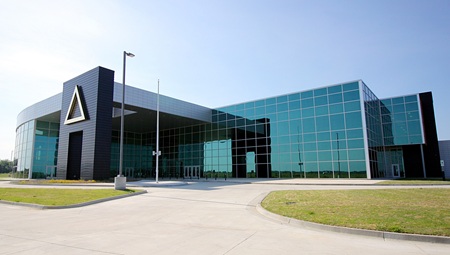
Terberg Taylor has since moved into their plant in Lowndes County and EMCC has worked
with them to provide leadership training and other assistance.
The Communiversity, EMCC’s 145,638-square-foot facility, serves as an educational
hub for workforce development. Advanced manufacturing programs at The Communiversity
include Precision Machining & Manufacturing, Engineering, Drafting & Design, Electrical
Technology, Mechatronics Technology, Industrial Maintenance and Systems Based Automation.
EMCC also offers about 50 career technical and short-term, noncredit training.
In 2022, the WIOA Career Services department was created within the Workforce and
Community Services division to consolidate the many community service programs offered
at the college. The WIN Job Center now falls under the WIOA Career Services umbrella,
as do a myriad of assistance programs that were once scattered across the division.
“We focus totally on meeting a person where they are, helping them find their path
and working with them to develop a training plan, whether it is on the credit or noncredit
side,” WIOA Career Services Director Greta Miller said. “Then we assist them in eliminating
any barriers to getting into school or finding employment.”
Work-based learning is a priority, with an emphasis on paid internships, externships
and apprenticeships.
EMCC and Steel Dynamics’ (SDI) Flat Roll Group in Columbus are entering their fifth
year for an apprenticeship program that started out with a cohort of 10 EMCC students
and has since doubled in number with the expansion of the apprenticeship program to
Aluminum Dynamics, a $2.5 billion aluminum flat-rolled mill that recently opened adjacent
to the SDI facility and operates under the SDI umbrella.
The students, who are selected through an application process, are paid to work and
attend EMCC. SDI also pays the students’ college tuition and fees. Once they graduate,
the students are hired as full-time employees at SDI or at Aluminum Dynamics.
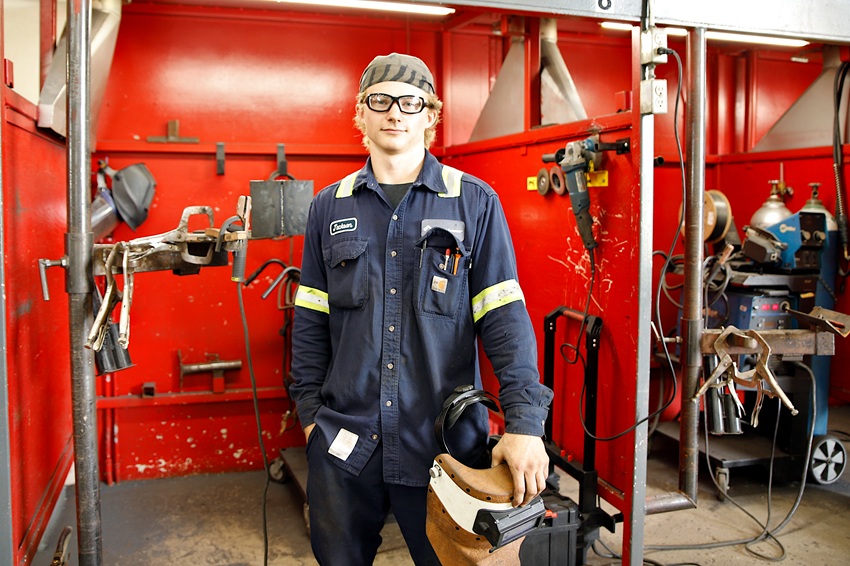
Caledonia resident Jackson Wallace will graduate from EMCC’s Mechatronics Technology
program in May of next year. He was selected about a year ago to serve as a millwright
apprentice at Aluminum Dynamics.
“Millwrights do mechanical maintenance work on things like bearings and couplings,
and we weld parts, grease equipment and make repairs,” Wallace said.
His day begins at 6 a.m. when he arrives at Aluminum Dynamics for work, leaving there
to attend school at EMCC from 8 a.m. to noon. He then heads back to Aluminum Dynamics
where he works until about 4 p.m.
Wallace is among a group of interns at SDI and Aluminum Dynamics taking a welding
class at EMCC this summer.
“I am really thankful for the apprenticeship and to have the job,” Wallace said. “The
program at EMCC is really good and I am learning a lot at Aluminum Dynamics.”
SDI and Aluminum Dynamics are among several local industries partnering with EMCC
through the Mississippi Industry Experience Program, a work-based learning initiative.
Some of the internships are like those at SDI, while others are set up differently.
Eligible Yokohama Tire Manufacturing Mississippi employees can apply to enter their
apprenticeship program. Those accepted are sent through EMCC’s Systems Based Automation
program. Like SDI, Yokohama pays the employees’ tuition and fees, and they are paid
while in class. If they complete the program and earn good grades, they can move into
a maintenance role at the plant located in West Point.
Global Cellulose Fibers, formerly International Paper, has a summer internship program
for EMCC Industrial Maintenance and Electrical Technology students. Southeastern Timber
Products in Ackerman is putting three of their employees through EMCC’s Industrial
Maintenance program beginning this fall, and Huber Engineering is interested in participating
in the EMCC internship program once their plant is fully operational.
“I have 39 participants in the Mississippi Industry Experience Program that will start
school on Aug. 17 when fall classes begin,” Miller said.
There are other apprenticeship programs at EMCC as well. The WIOA department funds
paid internships for qualified applicants to area businesses looking to hire. WIOA
can pay up to 320 hours, or eight weeks of paid work experience for students and the
general public at no cost to the employer.
“That gives both the company and the individual the opportunity to see if they are
a good fit,” Miller said. “With that program, the retention is very high because we
screen the students and the individuals.”
EMCC also offers specialized noncredit training to area industries. Some of those
include composites and avionics training for employees of Airbus Helicopters, Aurora
Flight Sciences and Stark Aerospace. Some employees at PACCAR Engine Company are taking
specialized welding courses this summer at EMCC’s Golden Triangle campus and EMCC
Electrical Technology instructor Cecil Pittman teaches a monthly safety class for
employees at Columbus Light and Water.
Other companies, like Burns Dirt, work with EMCC’s Truck Driving instructors to offer
their employees CDL (commercial truck driving) training.
“Much of what we already do at the community college level revolves around aligning
the needs of industries and the students we serve,” Alsobrooks said. “By the very
nature of what we do, we are contributing to Mississippi’s economic wellbeing. We
have a part to play, along with our great partners at the state and federal level,
such as AccelerateMS and the Appalachian Regional Commission. The Jobs Promise Performance
Program is a natural extension of our collective efforts to ensure we are best serving
our respective communities and the state at large.”



 Visit a Campus