14may
LESS FRICTION, MORE TRACTION: WHAT ACCESSIBILITY REALLY MEANS FOR OUR STUDENTS
News
May 14, 2026
By Scott Baine, Center for Teaching and Learning, East Mississippi Community College
When I first was tasked with leading our accessibility efforts in instruction, I was
not an accessibility expert. I still would not call myself one. What I am is someone
who cares deeply about our students and our instructors, and what once sounded overwhelming
has become the most meaningful work I do.
"East Mississippi Community College is a public community college dedicated to improving
the quality of life for students, community, and personnel through instructional opportunities,
with a specific focus on a healthy mind, body, and spirit." That mission is not just
a statement on our webpage. It shows up in the classroom, in course design, and in
the daily decisions our instructors make. A student using her screen reader should
be able to navigate all her courses without barriers. A student watching his required
course videos should not miss something because captions are unavailable. A student
relying on assistive technology should not hit a wall because a document has no format
structure. A student on a phone should not have to scroll through ten weeks of content
just to find what is due this week. These are not outlier cases. They are everyday
realities for students across all our campuses and modalities.
Accessibility is not really about technology. It is about whether students can participate
in learning. Federal law agrees. The Americans with Disabilities Act requires all
public colleges and universities to meet digital accessibility standards by April
26, 2027.
My mantra for this initiative is simple: less friction, more traction. The goal is to keep students focused on the material and make sure nothing stands
between them and what their instructor worked hard to build. I have spent the better
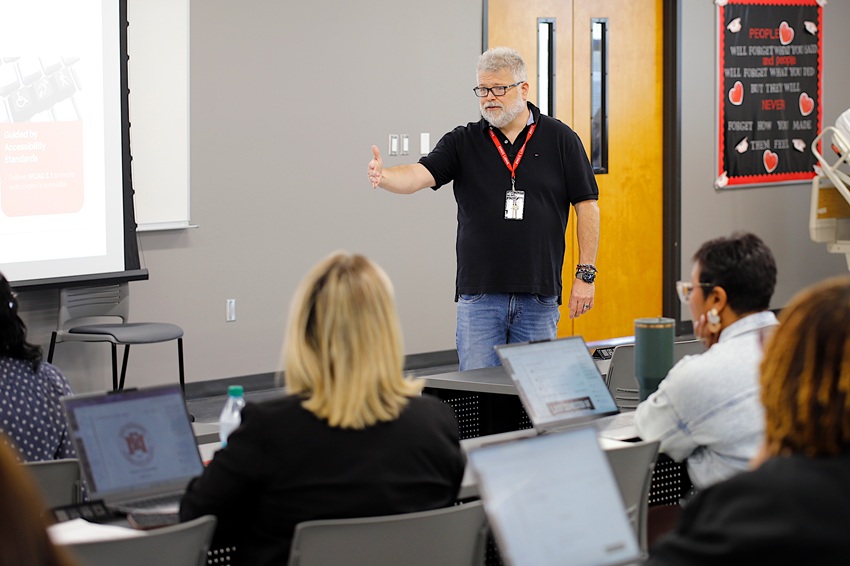
part of the last three semesters sitting down with faculty one by one and in group
settings, across every division and every campus, working through what accessible
teaching actually looks like in practice. We have talked through alternative text,
video captions, heading structure, color contrast, descriptive links, and document
formatting. All of it matters more than most people realize.
The curb cut was not built for everyone. It was designed for people who use wheelchairs.
But it helps people pushing strollers, delivery workers with hand trucks, and students
carrying heavy backpacks. Accessible course materials work exactly the same way. When
we design for the students who need it most, every student benefits.
The foundation for this work comes from internationally recognized digital accessibility
standards established by the World Wide Web Consortium, the organization responsible
for the guidelines that govern how web content and digital materials should be built
so everyone can use them. Part of the role of our Center for Teaching and Learning
(CTL) is helping faculty approach that work in ways that are manageable and realistic.
I will not pretend this is a light lift. Our instructors are extremely busy. They
built their courses over many years. Revisiting documents, videos, and course materials
takes time and intention. I know that. I feel it, too. But what I have witnessed from
our faculty has genuinely moved me.
They show up. They ask hard questions. They stay engaged until something makes sense.
Faculty who once felt uncertain are now helping colleagues rethink how course materials
are designed and delivered. Instructors who came into their first consultation overwhelmed
have left with a plan and the confidence to move forward. These are not people doing
the minimum. These are professionals rising to meet a genuine challenge with the same
determination that has always defined our faculty and our institution.
Our CTL accessibility resources in Canvas continue to grow as new topics and materials
are added. Individual consultations remain available at all campuses and virtually
throughout the upcoming year, and support continues across the coming academic year.
Federal law may have established the deadline, but as always EMCC faculty have embraced
something bigger than compliance.
In this together,
Scott
***
Whether you are a faculty member, a colleague at another institution, or someone who
simply believes every student deserves access to learning, I would love to hear from
you. Contact me and the Center for Teaching and Learning at ctl@eastms.edu.
Americans with Disabilities Act: ada.gov/law-and-regs/ada
World Wide Web Consortium: w3.org
Scott Baine | Center for Teaching and Learning | East Mississippi Community College



 Visit a Campus